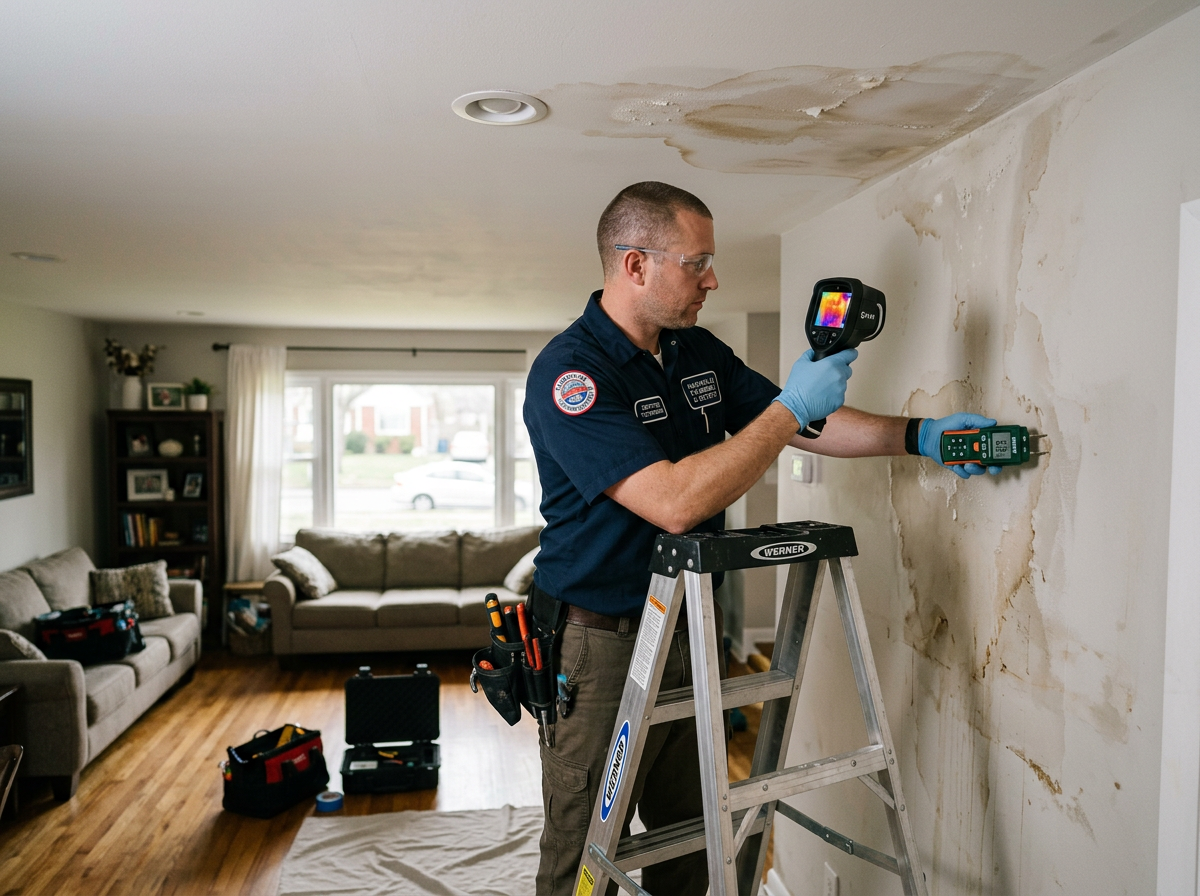
Nashville's humid subtropical climate brings hot summers that drive condensation along cooler pipes and cool winters that cause older supply lines to contract. In neighborhoods like Germantown and East Nashville many homes built before 1960 still carry galvanized or early copper lines routed through plaster walls. These lines often develop pinhole leaks that travel along joists and show up as brown stains on ceilings two rooms away from the actual breach.
We begin with non-invasive moisture meters and thermal imaging to map damp gradients across drywall and plaster surfaces. Acoustic listening and video scoping follow only where readings indicate active flow. In The Gulch and West End high-rises we also check shared risers that serve multiple units, because a leak on the floor above can migrate downward through slab penetrations and appear as a wall stain on the unit below.
Homeowners sometimes confuse roof leaks or HVAC condensation with plumbing issues. We isolate the source by pressure testing isolated zones and confirming with endoscopic inspection inside wall cavities. This approach keeps repairs limited to small access points rather than full wall replacement.
Technician insight
In Nashville the thing that catches most people out with ceiling and wall leak detection is how quickly a small pinhole in a 1940s galvanized line in East Nashville or Germantown can travel along floor joists and stain a ceiling two rooms away; the humid summers keep the moisture moving instead of drying out like it might in drier climates.
West End Condo Ceiling Stain
A homeowner in a 1970s West End building noticed a spreading brown mark on the living-room ceiling after a week of heavy rain. Moisture readings pointed upward into the bathroom floor above rather than the roof. We isolated the tub supply line, confirmed a slow leak at an old soldered elbow with acoustic equipment, and marked a single 6-inch access point for repair.
Ceiling and Wall Leak Detection Services We Offer
✓Drywall Moisture Mapping
Pinpoint active moisture zones behind drywall in living rooms, kitchens, and bathrooms using calibrated meters and thermal cameras.
✓Plaster Wall Leak Tracing
Locate leaks traveling inside lath-and-plaster walls common in pre-1950 homes in Germantown and East Nashville without removing large sections.
✓Ceiling Stain Source Identification
Determine whether ceiling discoloration comes from supply lines, drain lines, or condensation in homes across Green Hills and Belle Meade.
✓Acoustic Listening in Wall Cavities
Use sensitive listening equipment to hear water movement inside finished walls when visual or meter readings are inconclusive.
✓Shared Riser Leak Checks
Inspect vertical plumbing risers in multi-unit buildings in The Gulch and Downtown that can leak into neighboring units.
Ceiling and Wall Leak Detection Cost in Tennessee
| Service | Typical Range | What Affects It |
|---|---|---|
| Standard Detection Visit | $275–$450 | Single-story homes with clear access; rises with multi-story or complex plaster construction. |
| Multi-Room Mapping Add-On | $125–$225 | Additional rooms or floors that require extended scanning. |
| Scope or Acoustic Confirmation | $150–$300 | When meter readings need verification inside cavities. |
Ranges are typical for Tennessee and confirmed with an exact written quote before any work starts.
How it works
- 1
Initial Assessment
Walk the affected rooms and note stain patterns, recent weather changes, and any history of prior repairs.
- 2
Non-Invasive Scanning
Run moisture meters and thermal imaging across ceilings and walls to map damp areas and narrow the search zone.
- 3
Targeted Confirmation
Perform acoustic listening or small-scope inspection only at the highest-probability locations to verify the leak path.
- 4
Access and Documentation
Create minimal openings if needed, photograph findings, and mark exact repair locations for the plumber.
Pricing
Most ceiling and wall leak detection visits fall into a mid-range service call because access and confirmation steps vary by home age and construction.